Happy birthday 🎊🎉 GNU/Linux.
Today GNU/Linux is 32 years old.
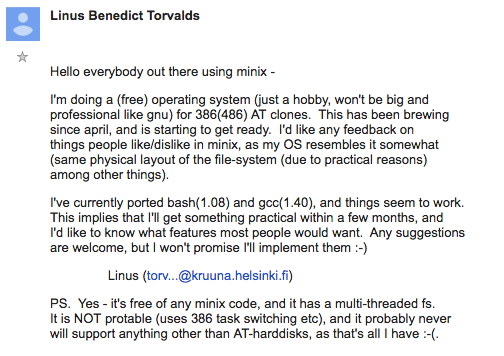
It was thankfully released to the public on August 25th, 1991 by Linus Torvalds when he was only 21 years old student.
What a lovely journey 🤍
won’t be big and professional like gnu
that didn’t age well
And this:
and it probably never will support anything other than AT-harddisks
Sure it aged well. WAY WAY BIGGER than gnu.
It is NOT portable (uses 386 task switching etc), and it probably never will support anything other than AT-harddisks, as that’s all I have :-(.
Famous last words
*protable
Imagine making a typo and it continually being shared and highlighted for over 30 years.
Kinda makes me glad I’ll never be famous for anything.
Well, Linux is 32 years old; GNU goes back to 1984, and Unix all the way back to 1970! The history of this OS is much older than Linus Torvalds’s involvement; he “only” created and maintains the most popular kernel.
But yes, happy birthday to Linux. Many thousands have contributed to making this operating system what it is today and they all have my utmost thanks for it.
It is a happy coincidence that the evening before the 1970s began, at 4pm Pacific, they decided to invent UNIX.
How so?
I think it’s a joke about how UNIX timestamps work. They count milliseconds from January 1st 1970, 00:00:00 UTC, which is 4pm the day before in PST. So the happy coincidence is that they invented UNIX at the very millisecond when its clock starts.
There, ruined the joke.
Oh right, the UNIX epoch actually starts when UNIX was invented
Somehow, I didn’t expect that…
Are you sure unix will be created in the year 3.843063914 E+5636(1970!)
How would anything even survive 3.843063914 E+5636 years after the end of the universe to make unix
They misspoke: Hurd will be usable in year 1970!
My brain gets numb when I start thinking about all the branches that have come from Unix… and the branches from those branches and so on.


If we are marking the birth of Linux and trying to call it GNU / Linux, we should remember our history.
Linux was not created with the intention of being part of the GNU project. In this very announcement, it says “not big and professional like GNU”. Taking away the adjectives, the important bit is “not GNU”. Parts of GNU turned out to be “big and professional”. Look at who contributes to GCC and Glibc for example. I would argue that the GNU kernel ( HURD ) is essentially a hobby project though ( not very “professional” ). The rest of GNU never really not that “big” either. My Linux distro offers me something like 80,000 packages and only a few hundred of them are associated with the GNU project.
What I wanted to point out here though is the license. Today, the Linux kernel is distributed via the GPL. This is the Free Software Foundation’s ( FSF ) General Public License—arguably the most important copyleft software license. Linux did not start out GPL though.
In fact, the early goals of the FSF and Linus were not totally aligned.
The FSF started the GNU project to create a POSIX system that provides Richard Stallman’s four freedoms and the GPL was conceived to enforce this. The “free” in FSF stands for freedom. In the early days, GNU was not free as in money as Richard Stallman did not care about that. Richard Stallman made money for the FSF by charging for distribution of GNU on tapes.
While Linus Torvalds as always been a proponent of Open Source, he has not always been a great advocate of “free software” in the FSF sense. The reason that Linus wrote Linux is because MINIX ( and UNIX of course ) cost money. When he says “free” in this announcement, he means money. When he started shipping Linux, he did not use the GPL. Perhaps the most important provision of the original Linux license was that you could NOT charge money for it. So we can see that Linus and RMS ( Richard Stallman ) had different goals.
In the early days, a “working” Linux system was certainly Linux + GNU ( see my reply elsewhere ). As there was no other “free” ( legally unencumbered ) UNIX-a-like, Linux became popular quickly. People started handing out Linux CDs at conferences and in universities ( this was pre-WWW remember ). The Linux license meant that you could not charge for these though and, back then, distributing CDs was not cheap. So being an enthusiastic Linux promoter was a financial commitment ( the opposite of “free” ).
People complained to Linus about this. Imposing financial hardship was the opposite of what he was trying to do. So, to resolve the situation, Linus switched the Linux kernel license to GPL.
The Linux kernel uses a modified GPL though. It is one that makes it more “open” ( as in Open Source ) but less “free” ( as in RMS / FSF ).
Switching to the GPL was certainly a great move for Linux. It exploded in popularity. When the web become a thing in the mid-90’s, Linux grew like wild fire and it dragged parts of the GNU project into the limelight wit it.
As a footnote, when Linus sent this announcement that he was working on Linux, BSD was already a thing. BSD was popular in academia and a version for the 386 ( the hardware Linus had ) had just been created. As BSD was more mature and more advanced, arguably it should have been BSD and not Linux that took over the world. BSD was free both in terms or money and freedom. It used the BSD license of course which is either more or less free than the GPL depending on which freedoms you value. Sadly, AT&T sued Berkeley ( the B in BSD ) to stop the “free”‘ distribution of BSD. Linux emerged as an alternative to BSD right at the moment that BSD was seen as legally risky. Soon, Linux was reaching audiences that had never heard of BSD. By the time the BSD lawsuit was settled, Linux was well on its way and had the momentum. BSD is still with us ( most purely as FreeBSD ) but it never caught up in terms of community size and / or commercial involvement.
If not for that AT&T lawsuit, there may have never been a Linux as we know it now and GNU would probably be much less popular as well.
Ironically, at the time that Linus wrote this announcement, BSD required GCC as well. Modern FreeBSD uses Clang / LLVM instead but this did not come around until many, many years later. The GNU project deserves its place in history and not just on Linux.
Can this be the new GNU/Linux copypasta?
The BSD license allows incorporation of BSD code in non-free projects. That was both an advantage for capitalists while simultaneously moving hobbyists away from it’s development. Kind of an important bit of info.
Something is open source or isn’t. There’s a set, binary definition.
I get the feeling you’re implying a difference/aversion between those two terms which doesn’t exist. This and the combination with a nonsensical statement about amount of GNU packages vs non-GNU packed makes it feel like you’re pushing an agenda here: There’s far more free software than just GNU’s - that’s a success for free software and the GNU project. There’s no connect between the argument you’re obviously implying.
Also HURD never took off - but why should it? The GNU project’s goal is a fully free operating system, with Linux being persuaded to adopt a proper license there’s no real need for HURD. It doesn’t mean it isn’t a fun project.Which two terms? Everyone has an agenda but I am not sure what I am being accused of here. Do you mean Free Software vs Open Source? The FSF goes to great lengths to distinguish between those two terms:
https://www.gnu.org/philosophy/open-source-misses-the-point.en.html
I am pretty sure my usage is consistent with the owners and creators of those terms. Have I made an error?
The error is in saying something is made “more open source”. The definition:
https://opensource.org/osd/
Does your license uphold these rules? It’s open source. Does it not? It isn’t.deleted by creator
That is not correct. Who is this “they” you are talking about? The OSI?
Open source is a term with a definition - which has been written by software freedom advocates by the way.
With free software you have politics and a philosophy, in which somebody can have more freedom or less with a piece of software. I really wouldn’t confuse that with the practicability of the OSI definition.
Copyleft or push-over is a whole separate topic. Copyleft might be favoured by software freedom enthusiasts, but I disagree with your idea of separation through that. Even if you don’t care about software freedom, you could like the practical effects of the AGPL.
I feel like you’re spreading at least misguiding information here.deleted by creator
These statements do not contradict anything I have said. Some people are pragmatic, some dogmatic about software freedom. So what?
Another correction since I am on a roll: Linux can’t switch from GPLv2. There are too many copyright holders, you’d never be able to contact all of them and get them to agree to a license change. Even if Linus Torvalds wanted to change, which I honestly don’t think would be a sensible thing to do in his position.
Open source is one thing but “free” is a lot of things.
Just a hobby 😉
Won’t be big
This is an interesting piece of history that I have never seen. Thanks for sharing
IDK about anyone else, but I first heard this story in the form of a song, and I still enjoy listening to it.
I love GNU/Linux.
Before I used Debian, I’d constantly fight with my operating system. Every time I opened michaelsoft binbows(which would take ages to open), I’d make sure that simplewall is running, so that bill doesn’t get any more info, after every 180 days, I’d run MAS to renew my office 365. I’d manually sync time since windows would use that same domain to send telemetry.
Now everytime I turn on my computer, the swirl of Debian greets me in a flash, my i3 being ready even before I sit.
I can spend hours doing work without any mandatory updates . It is an operating system that never makes me feel its presence. For that I’m grateful to people like Ian, Stallman, Linus, among countless others making my life better.
I can spend hours doing work without any mandatory updates .
Weird way to say spend hours fixing something that just randomly borked your PC.
Seriously, though. Windows has a fuck ton of issues, but it seems like every distro I install I am eventually greeted with something just completely breaking for no reason whatsoever and spend the next 6 hours scouring Linux forums for a solution, where everyone is just hostile as fuck screaming at people to “figure it out yourself” and to “use Terminal”.
Glad it works for you, though. Wonder how many downvotes this cold take is going to net me lol.
Weird way to say spend hours fixing something that just randomly borked your PC.
by work, I meant actual work, and not fixing something.
Last time I fixed something was a few weeks ago. It was MPV needing an update(which was totally my fault, as I often forget to do updates) as a yt-dlp script wasn’t working.As for something breaking, my experience has been the opposite. Probably because I don’t own any newest hardware and don’t do much gaming, or any other stuff that might require some proprietary service for optimal functioning.
Also, my experience with the community has been excellent so far. Even my basic questions(e.g.: dual boot) were answered promptly and nicely by the community(I mostly use #linux on IRC, or distro-specific forums like linux mint forum).
I’d suggest you to give GNU/Linux one more try. Probably try out something like Nobara if you’re into games. Or maybe Linux mint if you want it to just work.
Maybe you just weren’t lucky the first time.
And don’t worry about fake internet points. They mean nothing.
I use Ubuntu on my desktop and when I had an NVIDIA video card I did have fairly frequent issues when the proprietary drivers would update and then not play nice with something. That card died and I replaced it with an AMD video card and I don’t think I’ve had a “dive into the annals of gnu/Linux architecture” session since.
I also had some bad RAM at one point and spent a couple of hours trying in vain to boot into either Linux or Windows.
I do think it’s fair to say that there are some things that Windows handles a little more gracefully, but the situation is not nearly as bad as it used to be / people still tend to think it is.
I also have a Windows laptop, and from time to time I’ll have an issue that I’m trying to fix and I’ll end up on the Microsoft forum where someone asked my question and the answers are either answers to questions that weren’t asked or a set of steps that must have been based on a different build of Windows or something because there’s no way to follow them on my installation of Windows 11. So maybe that’s not hostile like the old school Linux forums, but it’s still unhelpful.
I think both are fine, both have their pros and cons, and those pros and cons aren’t as different as people make them out to be.
Is chatGPT any good at fixing Ubuntu problems?
I haven’t tried that, but my guess is generally no based on other things I’ve tried chatGPT for and things I’ve read. It would probably have some lucky hits and those would seem like magic, but it would mostly produce correct-sounding answers that don’t fix the problems.
I decided to try Linux Mint a few months back at work, and was very pleasantly surprised at how easy to use and just-works it is.
We use some fedora build VMs, but I generally have a monitor dedicated to Mint while having the company’s Microsoft stuff on another.
Yep, this has been my experience too.
People shit on windows, but it was easy to navigate, and generally made an effort to keep you from breaking it and you pretty much never had to enter a command line for anything as an average user.
Linux troubleshooting, especially for new people, is going to become a much bigger problem as time goes on because any searched solution basically boils down to copy and pasting stuff into terminal and hoping its 1)still relevant and 2) doesnt break everything worse. Which is probably why so many immutable distros have popped up, to give that windows level of protection.
As for hostility? Its still there, in pockets. Not so much on lemmy from what i’ve seen, but it still exists elsewhere… but it is significantly better overall than it was 10+ years ago, where questions about problems were seemingly treated as insults against the prophet and were responded to with great aggression, and often racist undertones.
Maybe I’m the minority, but I’ve never really broken my Linux. Sure, it’s NixOS, so it’s a little more stable than many other distros, but still, I have a much better time with it than I do with Windows
Amen to that.
A lot of Linux users have forgotten how tech-savvy they are even compared to the average power user. Saying “Linux just works” shows just how tone deaf they are.
As someone who didnt know anything about file systems besides FAT32 and NTFS, and as someone who isn’t comfortable using command line, trying to switch to Linux was horrible. On windows something might not work they way you want it to, but it does kinda work. On Linux I felt like I had to fight every step of the way to do simple tasks.
Its like buying a car - I’m not a gearhead, I just want something that gets me around when I put petrol in. I want to drive it off the lot, even if there are a few maddening features like the cup holder being in the wrong place. I don’t want to have to choose the right wheels and assemble them, I don’t want to have to buy seats and install them, and I don’t want to stop every other day to figure out why something isn’t working.
Weird esoteric issues happen on Windows too. I had a bug where I couldn’t create a new folder from Windows Explorer, which I never figured out and didn’t resolve itself with reboots or even Windows updates. I probably could have spent a half day tracking it down and fixing it, but someone less tech savvy would probably have had to reinstall Windows. Instead I just popped a terminal and used mkdir whenever I needed a new folder until I upgraded to Windows 11 and that resolved it.
Point is, computers just suck sometimes regardless of what software they run. Or I’m just a magnet for ridiculous arcane bugs, you decide.
This might come across as Linux fanboyism but I currently have Linux, Windows, macOS, iPadOS, Android, and FreeBSD all running on various devices around my house and they all suck in their own unique ways.
While we’re on the subject of esoteric issues with Windows, Update just recently had a bug where it couldn’t update if your Recovery partition wasn’t big enough. The Recovery partition that was created on install. Automatically. By Windows.
What on earth are you talking about? Windows is the king of a system just breaking itself for seemingly no reason with no way of fixing it. At least on Linux, I know there’ll be hundreds of forum posts telling me how to fix something.
every distro I install I am eventually greeted with something just completely breaking for no reason whatsoever
This happens on Windows too and the fixes you have to apply aren’t less esoteric.
For example: User complains that Spyder won’t start on her brand-new laptop. Installation seems perfectly fine, nothing wrong there, no corruption or obvious missing bits. Dig around in the Windows log files, find some fairly generic error. Do a bit of googling, eventually decide to just search Github for issues mentioning Spyder not loading. Turns out the laptop is just too new and the AMD graphics driver Windows installs on its own has issues with the IGPU. So replacing that with newer the version AMD distributes fixes it.
Or, with Windows 11, if you want the start menu on the left and the Explorer context menu usable: Sure, just open powershell and run these commands to create new, weird registry keys to force it, btw these are not supported by Microsoft, you’re on your own.
I’d rather choose the OS that doesn’t have the audacity to charge money and then blast me with ads in the start menu.
happy birthday you bloody penguin <3
Ah yes, the guy they named Linus Tech Tips after. 😇
/s
“Just a hobby”–famous last words
Did stallman coat-tail Linux on day one, or did he latch onto the “ackshually, it’s got some gun in there so we deserve top billing” only a little after?
No, its because Linus Torvalds doesn’t consider libre software to be important. Torvalds sucks when it comes to free software.
GNU Hurd is an incredibly important project because there can’t be just one “free software kernel.”
Richard Stallman doesn’t care about popularity. He already changed the world. What he does care about is people forgetting their commitment to freedom.
He doesn’t give a shit if people say Linux, he does give a shit if people are “marketing” Linux without an emphasis on freedom.
Something that many have failed in.
What’s holding GNU/Hurd back? Can’t be hardware anymore since it became blazing fast
Nothing is holding hurd back. Debian and GNU Guix both ship hurd. The world has failed hurd instead.
Hurd will never accept firmware blobs or proprietary drivers. Thus, it will not work on OEMs who use those tactics for their machines. You are still able to install hurd in a VM as those have libre standards.
This is true for all GNU packages, not just hurd.
Oh that’s sad. The nature of commerce and competition means that proprietary stuff will never go away because making closed stuff is the way MBAs are taught to create “competitive advantage”
The strategy of the GNU project is to create and support as much free software as possible to make proprietary software obsolete.
Firmware is one of the biggest hurdles as the freeworld has the userland locked down for the most part (albeit some editing software like CAD or becoming feature competitive with photoshop).
There will always be people seeking to control others through dirty licenses and EULAs. The solution is not to target them (yet!) but to reject them and empower ourselves.
If that means not being able to use a wifi card: use an adapter! Or use ethernet. If that means we can’t get microcode, we’ll find cpus unencumbered by patents or reveree engineer them. Want to use an apple m1? There are people trying to liberate that machine as much as possible.
Probably after he gave up on his own kernel (Hurd) being a viable competitor.
I hate this language, its so fucking dehumanizing. “Viable competitor” is such bullshit. Torvalds gave away his commitment to freedom with binary blobs. That’s his decision to do. But to label Hurd on that same level is the biggest disservice to history you could ever do.
Hurd will never be the “viable competitor” because you hold selfish attitudes about how makes software valuable or not.
Torvalds sold out. Hurd didn’t.
I first recall him trying to shoulder surf Linux’s popularity not long after the XFree86 project switched to a new license that included an acknowledgement clause, so around 2004/2005. I still chuckle when I see that he wants me to call it GNU/Linux, but he has a shit hemorrhage because XFree86 added a license clause requiring similar labeling. He’s made more than his share of contributions, but he takes pedantry to a whole new level.
happy birthday mr torvold
I read in “The Cathedral and The Bazaar” that Linux was not that revolutionary (it reused code and ideas from Mimix) but the collaboration of the entire talent pool from the Internet to develop the kernel is. Massively respect for Linus.
Love to see this piece of history!